AT-Communities #1: the Concierge, the Vault, and the Fuck-ass Astro Website
In which I try to make sense of communities on ATproto.
Table of Contents
This article comes after reading Daniel’s thoughts on Bluesky’s move towards
Community, when
Boris torpedoed my week wisely suggested I say
something on the topic of ATproto Communities.
If you haven’t heard much about them yet, the shallower end of my feelings is best summed up by what I told Boris right as I closed off Daniel’s article:
“I want Bluesky to own my community just as much as I want Bluesky to own my PDS1”
And that—hasty disclaimer before the “Yeah! Fuck Bluesky!” starts—is a non-zero amount. Indeed, Bluesky currently holds not only my personal PDS, but the username others @ me by. And I’m fine with that! Genuinely!
If you balk at this, consider I have solid reasons for not moving off my cozy defaults:
- I’m lazy
and busyand lazy - For any reason I want, whenever the urge eventually hits, I can swap out the service hosting my data2 and ditch Bluesky forever—which means I feel no particular pressure to do so right now.
Similarly, if I’m ever to kick off my shoes, relax, and trust Bluesky—any service!—with hosting a community I “own”3, then everything surrounding the community’s identity and function needs at least as much credible exit4 as an individual user does.
Put plainly:
To live up to the protocol’s original promise, an ATproto Community must be able to leave a rogue service with everything it needs to take root somewhere else—far, far away from its reach—with as little disruption as possible.
Luckily, that’s exactly what Daniel and the others who’ve been working on this have been building and writing essays about5! So this article is not me barging in, shining armor on, rectifying something that’s about to go wrong. This is just me—who’s been prodding the protocol, building a prototype of an ATproto Community, and spending a few years looking at the “how the fuck do we online community” issue—finally getting off my ass and writing down what I know, believe, and have been taught about how we should do community on ATproto.
And to start, I’m going straight to the million dollars question…
What is an ATproto Community?
It’s hard to define what “a community” is, but here’s some of what a community
is not: a community is not the place people meet; a community is not
its members; a community is not its admins, moderators, or (for what it’s worth)
its “owners”. In a way, “a community is an idea vibe, and ideas
vibes are bulletproof unknowable”.
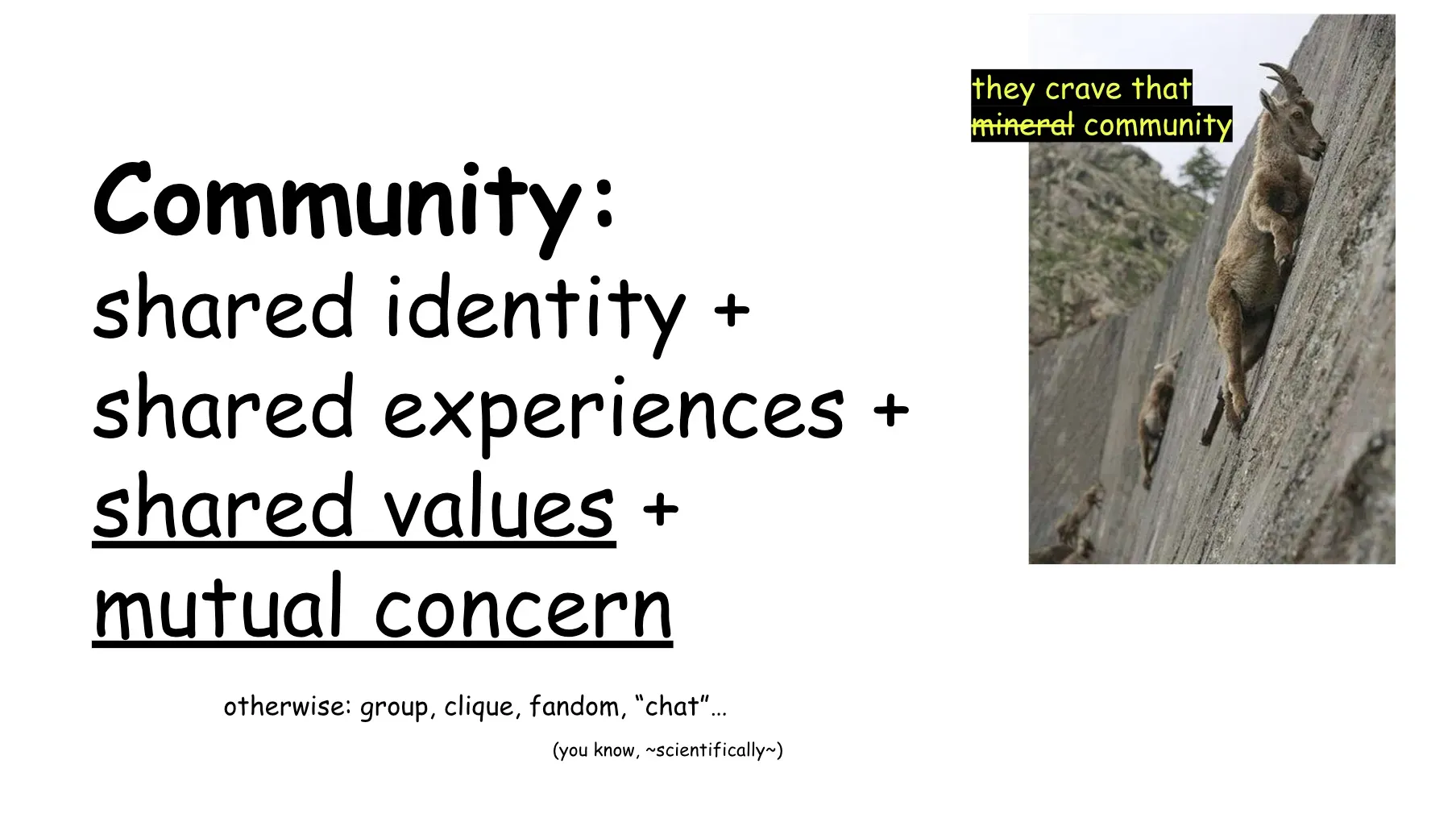
Oh look! I have a slide for that!
What’s very much knowable, however, is that once you build a technology that
connects people across the web (like ATproto does) people will soon yearn for more
than just sharing porn expressing themselves. They will seek to build “group
spaces” to share porn find belonging in a larger whole. And now that the
moment has come for us, folks are racking their brains—all together!—so
ATproto Communities can live on this protocol the way a user does—owning their
identity, their data, and their freedom to fire any service that stops meeting
their needs.
And here’s the lucky deal: we don’t need to define community to design how Communities may be done on ATproto! Or at least, it seems many are hovering around similar ideas, no matter what shape the concept holds in their brain.
Thus, a Community on ATproto will likely have:
- Its own DID—that is, its own independent identity in the larger ATmosphere
- Its own PDS—that is, its own place to hold its own data
- Some “entity” that can read and write data on its behalf—often referred to as “the Arbiter”, after Zicklag’s conceptualization of it
This is accepted enough that we may as well consider it settled—or “almost settled”, to be precise. Even as the general shape is taking hold, the third piece—that entity that acts on the Community’s behalf—remains slippery, with everyone grasping at its edges just to see it unravel against some particularly sharp corner…
The Thankless Job(s) of the Arbiter
Last week, Zicklag generously lent me some time to walk through the Arbiter’s design together. My plan was to learn its more practical ins and outs, so I could jump on stream myself and walk less-technical “AT-izens” through the shape of ATproto Communities—something now postponed (not replaced) by this article.
For the curious (and only the curious), here’s the resulting diagram6. It was never meant as anything more than notes to myself, and it’s not required to read the rest—if you, like me, hate spoilers, it may even detract.

Cutting a long discussion short, Zicklag and I spent the afternoon teasing apart the Arbiter’s various responsibilities, which (Zicklag explained) have evolved alongside the concept. What started as a single block of functionality is now “separating” into distinct, potentially independent roles:
- Custodian of the keys, holding the credentials to read and write the Community’s data
- Member Manager, knowing who’s a Member of the Community and who’s allowed to do what
- Community Host, keeping track of the public and private spaces of the Community, and fetching data on the Community’s behalf
Of course, I’ve been rotating all this in my brain ever since. And as I rotated, I kept circling back to a thought: these aren’t just roles, they’re jobs. Jobs that a Community should be able to hire (and fire!) for, jobs that—Zicklag said so himself—could in principle be taken up by a different service, run by a different party, and swapped out independently.
But if each exists on its own, then a Community looks less like DID + PDS + Arbiter, and more like a complex weave of jobs to be done, relationships to maintain, and Members to serve: all requests swiftly routed or handled; each credential continuously checked; and information properly filed and retrieved—across countless members, roles, guests and “hired hands”.
Which means a Community needs more than just a bunch of services—
A Community needs a kick-ass manager. Something that can keep it all straight: do the calls that need calling, delegate what needs delegating, and ultimately satisfy not the requirements of individual jobs, but the needs of the Community itself.
That is, it needs its own Concierge.
The “Arbiter” Concierge
I’m not here to argue the difference between Arbiter and Concierge: Zicklag himself mentioned the name “Arbiter” was not particularly well-suited, and we seemed to agree “Space Host” was unwise in a decentralized network. I had off-handedly suggested “Porter” as an alternative, but Concierge sounds a hundred times cooler (very important), and still centers service over judgement (also nice).
Which is to say, the Concierge is my flavor of the Arbiter…maybe. Or maybe it’s something different. Judgement is still open—all I ask right now is that you picture it as Charon from John Wick.

In my conception of the Concierge (“I need it to look like a distinguished, hypercompetent, and kinda-threatening hot fictional man” aside) what matters most is that the Concierge is not the Community itself. It’s a Community delegate: a service the Community has hired to handle matters on its behalf, neither part of it, nor inseparable.
To have the same credible exit as regular users, a Community must be able to continue existing without a Concierge—with degraded service if needed, but with all it needs to rebuild operations safely in its hands.
This means a Concierge’s role is not to hold the Community’s data or its credential. A Concierge may not hold the full set of keys, nor manage Members directly. It may not have read access—never mind write access to every record of the Community. But:
- It knows how and who to ask to satisfy the request being made
- It knows who is allowed to make that request
- It knows whether they have clearance to receive the response
- …and if it doesn’t know directly, it knows how to find out!
When a request comes in, the Concierge handles it by getting the right things done: reading data where it can, writing where it should, coordinating with other services (internal or external) where needed. And if:
- The Concierge holds scoped, revocable permission to act on behalf of the Community and fullfil its needs and its Members’
- Community data lives somewhere the Community owns
- The job of Concierge can be easily reassigned to “whoever” comes next
then a Community can always walk away. It can fire its Concierge. The Community keeps existing across the swap; only the manager changes.
When a Concierge stops “sparking joy”, the Community elects a new one just like it did each time—through sign up, configuration, and continued usage. Give it access to the data, ask it to route requests appropriately, and let it take care of whatever needs to be done.

Sometimes things that are hard are worth doing; other times they aren’t, but some fool (me) needs to prove they’re possible; and sometimes, like this one, it’s both.
That is not to say electing a new Concierge is not a UX challenge—but so is a
PDS. It may not be easy (to start!), it may be slightly confusing (to
start!). But should a burning-enough happenstance light the laziness inertia
off the ass of communities like mine, they’ll be clamoring to yeet their
“signup-assigned Concierge”—to replace it with one more suited to their needs
and, if necessary, principles.
And the promise of ATproto is that we’d let them.
There’s an App for That!
You may be squinting:
“You’re describing a service that holds a credential that the Community can authorize and revoke, which allows it to read and write Community data, and coordinate actions on the Community’s behalf. So you mean like…a Community App?”
Why not, let’s call it a Community App! Habitat already has a notion of installable apps that act on a Community’s behalf; so does OpenSocial, which I used to prototype atmosphere.community.
None of this is about whether the Concierge is something installable by the Community, or how it gets installed. The distinction is more subtle, and it’s best teased apart by looking at my experience with OpenSocial7, how today’s zero-generation ATproto-based Community Apps interface with random websites like atmosphere.community, and most importantly why they work that way.
AT-Communities: You(r Members) Have No Power Here
When a user logs into an ATmosphere service, they go through one of computing’s most sacred and accursed courtship rituals: OAuth—feared and revered (but mostly feared) by developers everywhere8. In this dance, a website or app presents itself at the door, fans out its requested scopes, and asks the User for permission to write data or take action on their behalf. The User may accept the proposal by logging in and tapping “Allow”, or leave the would-be suitor stranded at the redirect URI by cancelling the process9.
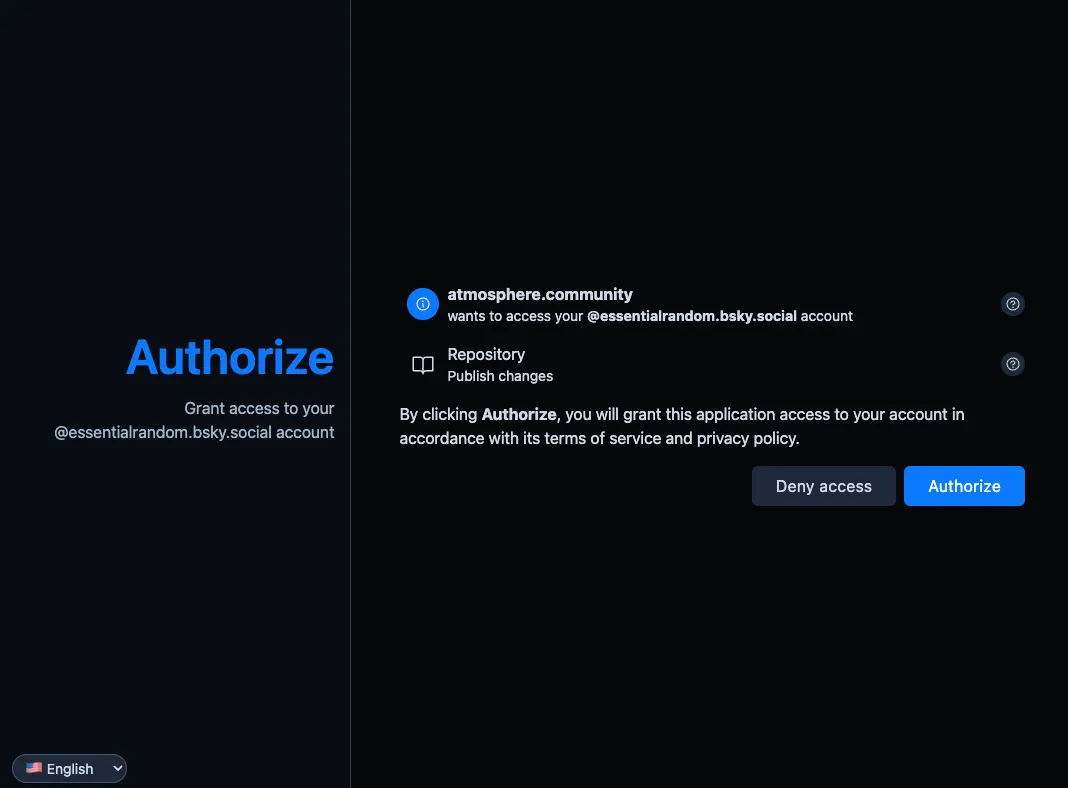
So many tears shed over such simple screens.
But while the dance is the same for every user and service, there is a fundamental distinction between a “User” logging in to a service, and a “Community Member” logging in to one:
- When a “User” logs into a service using their ATmosphere account, they may grant a service authorization to act on their own data—which may mean permission to update the User’s Bluesky profile, publish a leaflet on their behalf, or other cool things you can do with ATproto.
- When a “Community Member” logs into a service using their ATmosphere account, they may grant a service authorization to, well… act on their own data. But crucially a “Community Member” has no power to grant the service permission to act on the Community’s data itself—like writing shared content on the Community’s PDS, removing a rogue user from its list of Members, or removing themselves from it. After all, they don’t have that permission themselves!

Pictured: a Community’s PDS when a Community Member asks for, well… anything.
This perfectly logical distinction creates a quite obvious, quite big problem for Communities on ATproto: only those who log in with the Community account itself can grant a service permission to act on the Community’s behalf10, but a Community account cannot be shared with every single Member.
To get around this limitation (and stop me if you’ve heard this before), there needs to be an intermediary program that the Community’s own account has pre-authorized, which can take action on behalf of the Community for valid requests—including those coming from Community Members.
That is the role of OpenSocial11.
When a User wants to create a Community Account on ATproto, they:
- Login to OpenSocial (or equivalent) as their Community Account-to-be
- Grant OpenSocial permission to act on the Community Account’s behalf
- “Write” into the Community Account’s PDS that their regular, everyday User Account is the Community Admin
- Send Users to the Community’s OpenSocial Page, where they can login and ask OpenSocial to “write them” as Community Members
And they all lived happily ever after.
Now Featuring: “Third-party” Services
You may be wondering: does that make OpenSocial the Community’s Concierge, elected when the owner of the Community Account granted it power to act on the Community’s behalf?
As someone would say, “You’re Absolutely Correct!”—which is not wrong, but, as we all know, comes with asterisks and caveats.
Let’s poke and prod: what happens when a Community Member logs into another Service that’s not OpenSocial and takes an action that requires permission to modify Community Data?
- The Community Member cannot grant the Service permission to modify Community Data
- The Community Account could grant that Service permission if the Community Member had access to the Account
- But OpenSocial, like all good services, never sleeps12 and is always ready and available for those who need to “piggyback” on its permissions
This is exactly how atmosphere.community works:
The design of atmosphere.community, our first (spoiler warning) fuck-ass Astro website
Now, obviously, a new Service cannot just show up and ask to modify the Community’s data: the Community needs to authorize it first.
The way OpenSocial does this is the way most programs and most of the ecosystem does it:
- A developer registers a third-party App
- The App gets added to the Community, and receives its blessing13 to interact with its data
- That “Blessed App” is now allowed to write data and take actions on behalf of the Community.
…which is portable and works! Everyone has the power to create an App. The Community has total freedom to install new Apps, revoke App permissions, switch away from OpenSocial, or even pair it up with more services. OpenSocial even implemented App authentication via CIMD (a mechanism I loved discovering), which significantly lowered the friction for third-party App authentication!
So, in theory, all is good. The gods of decentralization smile upon us.
…or do they?
Blessed App Mode
That model never sat right with me, and I’m both very incensed about it, and full of doubts. Whenever I rant about this (and I have done at multiple points and multiple apps in the past), I always feel there’s something I’m missing: maybe it’s already possible and I’m not seeing it; maybe I’m being unreasonable about a problem that’s just plain impossible.
But, no matter how hard the technical problem of fixing it might be, there’s an issue I believe must be solved—if it hasn’t already been:
In Community App mode, the App is the unit the Community gives its trust to. The Community blesses specific Apps by installing them, and Blessed Apps get to write and act on its behalf.
So when a User with membership-granted permission to write Community data wants to use my random, no-one-heard-it-before, hyper-customized fuck-ass Astro website to add a record to the Community’s PDS, my fuck-ass Astro website’s options are:
- Become a Blessed App by convincing someone with enough permission in the Community to install it—which is not gonna happen at scale
- Go find an existing Blessed App that will let it piggyback on its credentials so it can take that specific action
Both of which are less than ideal, and both of which risk crushing the long-tail of small independent apps, websites, and utilities built for Members of Communities to interact with the Communities themselves—that is, all the fuck-ass Astro websites14 floating around in the ATmosphere.
Concierge Mode
In the mode I’m advocating for, which I’m calling “Concierge Mode”, Apps are not the only unit the Community gives its trust to.
In “Concierge Mode”, Apps have a standardized way to ask the Community (or *wink wink* a Community delegate) to trust the permissions of the entity the App is making requests on behalf of—whether it’s itself, a Member of the Community, or some random DID who asks to know or do something it may (or may not!) be authorized to, and thus may (or may not!) be allowed to do.
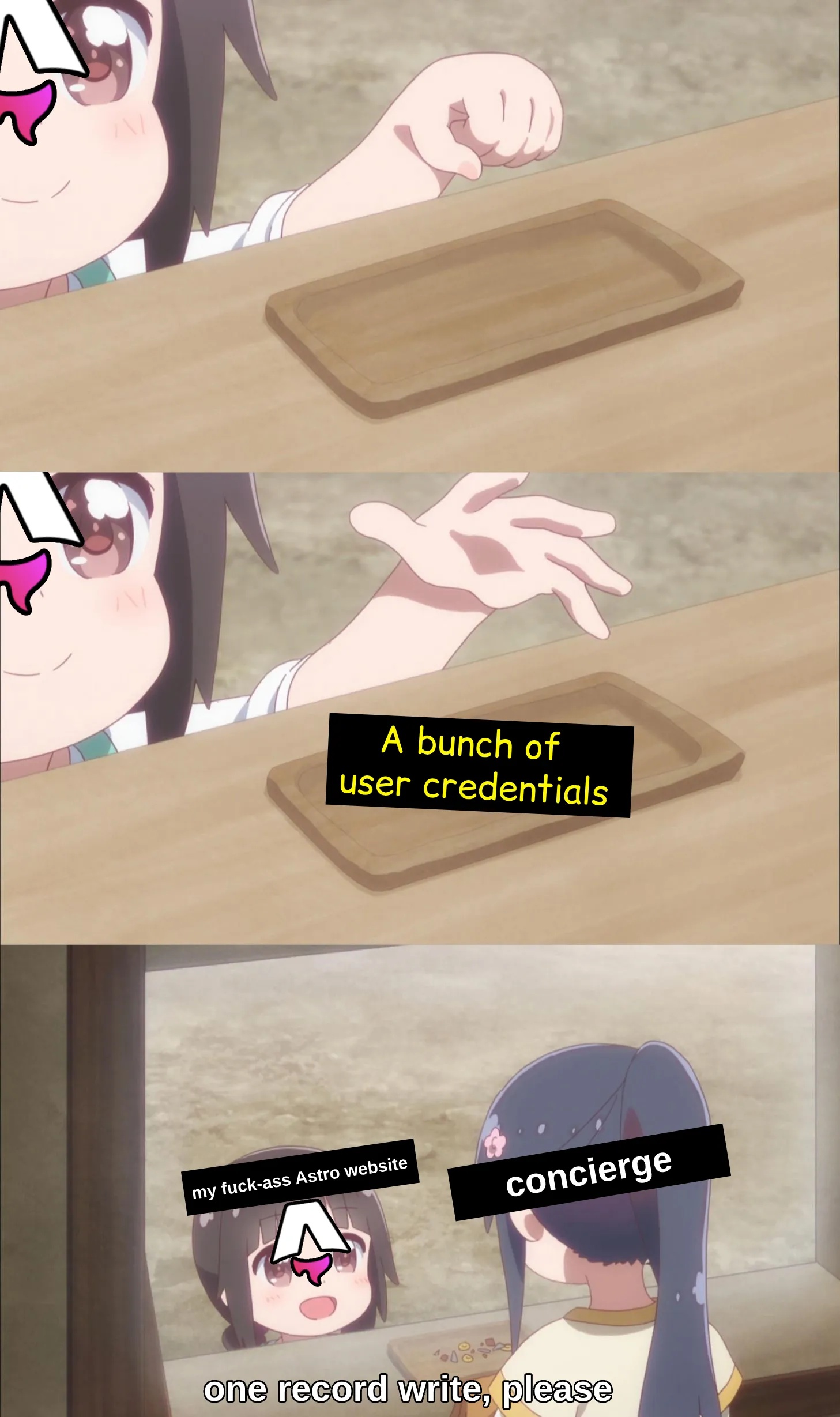
So, in Concierge Mode, my now-famous fuck-ass Astro website would:
- Go to the Community’s Concierge
- Present a signed request on behalf of the User (proof of origin and anti-tampering mechanism to be worked out), and ask the Concierge to act on it.
- Wait for the Concierge to handle it according to the policy of the Community and to the User’s role in it: checking with whatever services it needs, writing data wherever it should be, acting on the Community’s behalf so the User’s request can either be acted upon or denied
- Communicate the result back to the User
While it may seem simple, this flow is load-bearing: for the smaller Apps ecosystem to thrive, Services must be able to act on behalf of a Community Member with only the Member’s own credentials.
Because by piggybacking on the Member’s credentials, a fuck-ass Astro website doesn’t need to worry about whether it’s popular enough to end up installed, or whether anyone cares enough about it that they’ll pester a Community Admin to.
By piggybacking on the Member’s credentials, all a fuck-ass Astro website needs to do is bring the request to the Concierge, then go back to the User with the result—smile on its face, pepper in its walk, knowing it did the only thing it could: its best.
The Tyranny of Blessedness
You may be thinking:
Wait a minute— “Concierge Mode” is just the second option of “App Mode”: all fuck-ass Astro website did is “finding an existing Blessed App and piggybacking on its credentials”! Who cares if that App is the Concierge? Booo-oooh, give me my
moneytime back!
And in a way… yes, “Concierge mode” does require Apps to piggyback on someone else’s credentials! After all, a Member just doesn’t have permission to write the Community’s data on its own. It cannot be manufactured out of thin air!
“He’s* making a list/and checking it twice/gonna find out if you got access or no dice 🎵” (*or another service he knows about)
But there’s a fundamental difference:
The difference is that the third-party Service and the Concierge don’t have to trust or know each other. The third-party Service is not vouching for the requester: it’s just passing along a signed request, and asking the Concierge to handle it. This means that the Community doesn’t need to go around trusting Apps one by one to grant them permission. And that makes all the difference.
Because the issue with the Community Apps system is not the idea that Blessed Apps exist: not only should they be part of this ecosystem, they will need to be. The issue is that, by making the barrier to offering smaller, complementary, additional services to Community Members that much higher, Blessed Apps’ lack of scalability creates the risk of a “plausibly-deniable lock in”—a much greater danger where they’re the blessed (🥁) or only option. It’s fundamental to the ecosystem that AT-Communities be interactable through more than just installable Apps or API keys.
For the ecosystem to thrive, Third-party Services (and fuck-ass Astro websites) must have somewhere to go—a front desk, or a loosely-defined “person”—and ask that their Users’ legitimate requests be fulfilled by someone that holds the authority to do so. By taking on this role, the Concierge centralizes trust to act on behalf of Community Members—and by doing so, it decentralizes the power to make those acts happen.
But wait, there’s Room Vault for More!
Until now we’ve mostly focused on point #1 in our list of must-haves for Concierge Swappability—which required learning a lot about how AT-Communities and permissions work. With this out of our way, time to quickly breeze through the rest15.
Next up:
The Concierge holds scoped, revocable permission to act on behalf of the Community and fulfil its needs and those of its Members- Community data lives somewhere the Community owns
- The job of Concierge can be easily reassigned to “whoever” comes next
So, where should a Community’s data live? Well, it depends16:
- For fully-public data that can be accessed by everyone, Community data can live on the Community PDS—exactly like it does for regular Users.
- For private Community data that can only be accessed by a specific slice of Users or Services, the accepted answer seems to be “Permissioned Spaces”.
…and that’s that! A Community can own all its data, QED. Next up, reassigning the Conc—
“Fully-private” Community Data
AH! Got you! As if I’d keep it that short17.
There’s one more type of Community data, often forgotten or shoehorned into the previous two: the “fully-private” Community data that no Community Member should freely and fully access at all—not the Admin, not the most trusted Mod, not anyone. This is all data that belongs to a Community, but that in many Communities almost no one (if anyone at all) can read or write directly and in its entirety—nor, for the most part, wants to.
It may include things like:
- Historical logs of moderation infractions
- Identity of Anonymous Posters
- PII of Community Members (or anything that could be used to identify them)
- Detailed access logs
…and many more. This category of data often varies from Community to Community. Sometimes, data a Community kept semi-public may become more (or less) sensitive as it changes and grows.
In the current ATproto world, where data is all either public or private, similar data often ends up stored within individual App(View)s. And while Permissioned Spaces will “bring some back into the light”, it won’t fully eliminate the need for it. After all, for every piece of data you bring, I can think of a Community that may want it to be private and not directly accessible to its Members.
“Objection!” A voice rises from the crowd. “What about membership? In every community someone needs to know who its members are!”
“Do they though?” I ask, with the smugness of one who wrote community software where no one knew who the Members were, except for the database18.
Made-up conversations where I win imaginary arguments aside, what I’m stressing here is the difference between:
- Information someone must have access to read and write in its entirety
- Information someone must be able to access smaller slices of, in very specific cases
“Some Community Member (or Service) needs to know” is not the same as “some Community Member (or Service) needs to read and write that data directly”. After all, in traditional software applications, not having a direct connection to the database doesn’t prevent people from asking questions about its data: they just go through a server—an intermediary that mediates their access. And incidentally, that mediation, self-hosted software shows us19, doesn’t have to mean that the data is not in the Community’s hands.
Because in the future AT-Communities world, unless a solution for Fully-Private Community Data is available, the need for this data won’t stop existing: it will just end up within individual Arbiters (or Concierges) instead.
Enter the Vault-verse
Let’s dive into our current predicament, then! How should Communities deal with their Fully-Private Data? Ideally, this data would be:
- As much under their control as a PDS is
- Not a PITA to use
- Accessible to individual Users or Services according to their credentials, but with fine-grained access up to the individual record
…which is actually not that hard of a problem to solve! After all, ATproto developers already create stores of data that are not a PITA to use (problem #2) and can return fine-grained data to Users or Services (problem #3)—we just implement them over and over in every single AppView.
So let’s create one single data store! Even better: let’s put that single data store under a DID’s “control” exactly like we do with PDSes—which means we’re now also solving problem #1, in the same way we already know how.
I call this Community-owned Fully-Private data store “the Vault”.
The Vault is a data store that:
- is available as a service named
#atproto_vaultunder a DID, which keeps its content movable across hosts - doesn’t provide direct write OR read access to anyone but the owner of the DID (if at all), which keeps its data private, only accessible through a Concierge
- can be queried through specific XRPC endpoints using Lexicons—almost like a PDS can be—but with granular permissions that can get down to the level of individual records
Once again, you can think of “the Vault” as the community’s own internal SQLite database, like the one many AppViews build: just a standardized one with no access rights directly granted, and a “Concierge”20 in front to mediate access. Data that AppViews currently hold internally can either be mirrored into the Vault or placed there to start—either way, the data travels with the DID, not with whoever’s running the AppView at the moment.
The Vault is where the off-protocol state goes so the AppView doesn’t have to hold it—a data store that “speaks” ATproto-language, but is not necessarily ATproto-shaped. Not today, at least.
New Concierge, Who Dis~?
And here we are, facing our final requirement:
The Concierge holds scoped, revocable permission to act on behalf of the Community and fulfil its needs and those of its MembersCommunity data lives somewhere the community owns- The job of Concierge can be easily reassigned to “whoever” comes next
How do we enable a community to choose a different concierge should their current one prove less trustworthy (or less featureful) than they’d like?
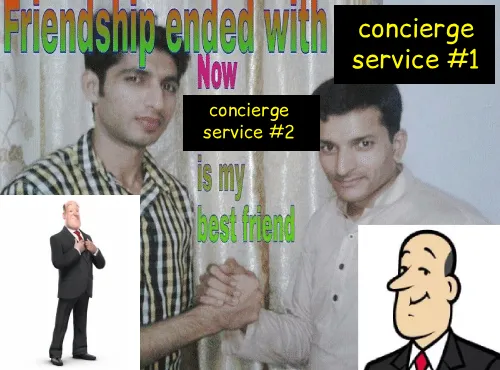
Concierge Service #2 here represented by famous internet darling and gay icon the Ask Jeeves butler
While this may seem like a hard question, its solution is already in front of us. And the journey we’ve been on until now has helped make it possible. After all:
- The new Concierge can be granted credentials by the Community Account to do its job, which makes it again possible for third-party Apps to act on behalf of Community Members
- The new Concierge can act on the same data as the previous one, including the private data in the Community’s Vault which removes the need to hold Community state in the Old Concierge Service itself
But there is one last issue, one we’ve until now overlooked…
New Concierge, Where It~?
The final hurdle: how does that random Service carrying the User request—our fuck-ass Astro website—know it should now go somewhere else to ask that it be fulfilled?
The same way it knows how to go find the Community’s PDS or the Community’s
Vault: by looking up the #concierge service in the Community’s DID
document.
When a Community writes a Concierge into its DID document, it promotes the Concierge as an official part of the Community, even as it remains an external Service not directly run by it.
Then all third-party Services need is:
- A standardized Lexicon to talk to Concierges (or other Services), even as implementations change
- A standardized way for Concierges to forward requests to other Services whose endpoints they don’t directly implement, as chosen by the Community rather than by the requester
This second bit may seem more involved than what we have today, but honestly? Not by much.
After all, the PDS already has a standardized way to proxy requests to other services, just one that doesn’t let it do almost anything on its own. In a way, the PDS is already acting as a Concierge—it just abdicates the responsibility of knowing about a DID’s preferred services21 and places it squarely on third parties.
What Makes a “User Account” a “Community Account”?
Once the Concierge is an official part of the Community DID, we get one final,
crucial property: we can use the presence of a #concierge DID entry as the
indication that the account is a Community account.
If this seems far-fetched… Well, it’s really not! Because this is exactly what ATproto does with labeler accounts today.
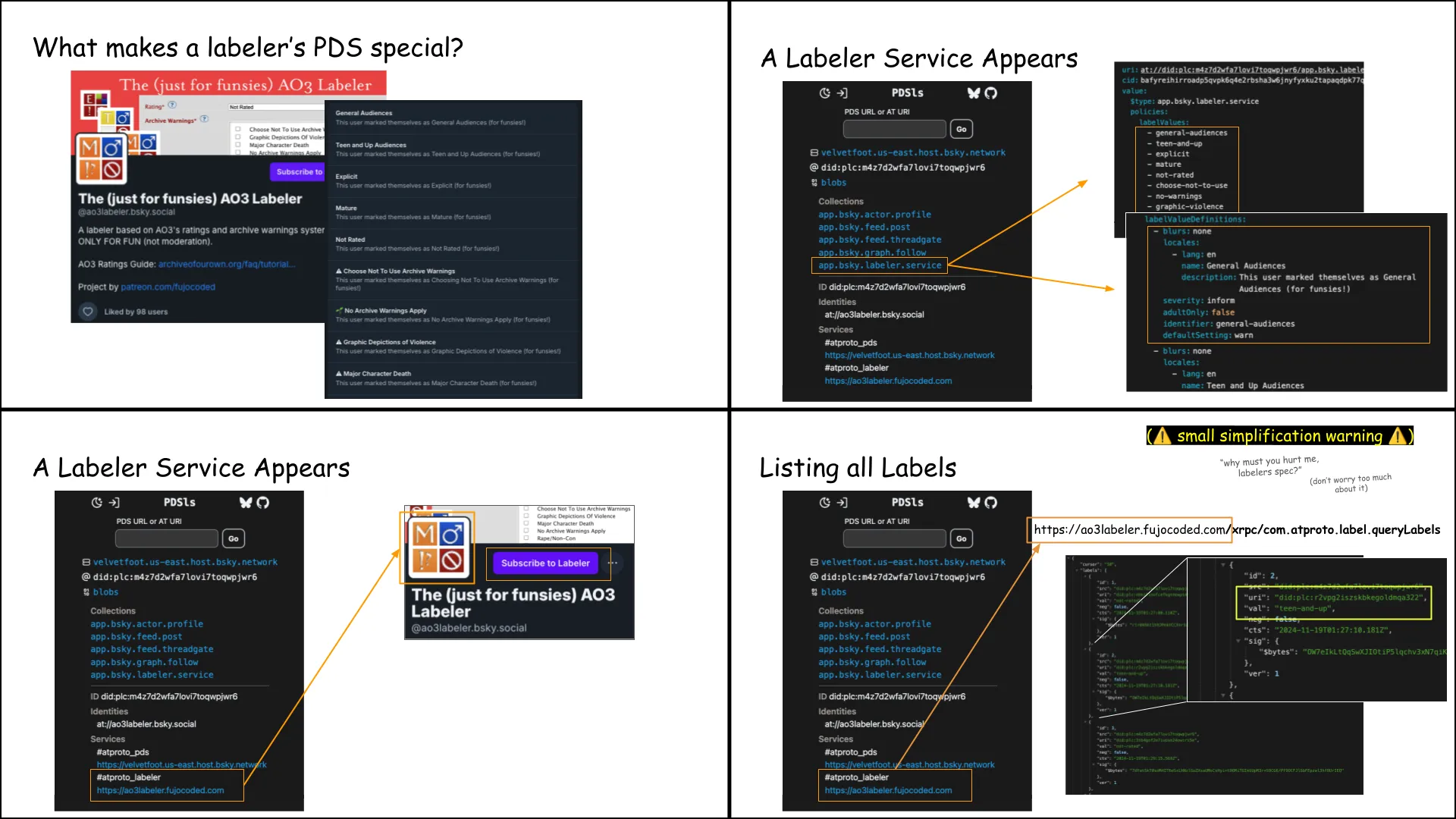
Slides from my ATmosphereConf talk, showing the presence of a Labeler Service in a User DID turns its Account into a Labeler Account on Bluesky and signals the presence of specific Labeler endpoints.
Once we do that, we have the pieces of the puzzle we need to:
- Let its Members act according to their privileges and permissions
- Let the Community itself own its own data
- Identify and interact with a Community Account through ATproto, no matter who implements the endpoints that make it a Community
And through this we can achieve exactly what we asked for at the very beginning:
ATproto Communities can live on this protocol the way a user does—owning their identity, their data, and their freedom to fire any service that stops meeting their needs.
We just need to build it.
— Intermission: Members Management in Practice —
SO! This article took a long time to write…and there’s a whole other part below it (yes, again, I’m so sorry, I swear it’s worth it). I’m going to publish the rest in a few days, but I wanted to show how this might look in practice.
I’d probably need another day to polish it up where I want it to be, but as they
say “¯\_(ツ)_/¯”. I’m not going to pretend I have all the answers. Still
there’s A Vision™ here which I believe is roughly, directionally a correct
shape to solve the issue—one that I’ve seen everyone involved hover around
without exactly pinning down its parts.
Here are my examples, in both read and write editions, using the community.lexicon
and com.atproto namespaces cause… well, I need some.
Have at it:
The Concierge — List Community Members Edition
— You either die a hero or live long enough to see yourself reinvent microservices
Here’s how it works, using the request to add a new Member to a community:
- Some Requesting Entity (App, service, Member, member-asking-through-App,
whatever) asks the Concierge to
“
community.lexicon.communities.listMembers” - The Concierge, consulting data it has access to (whether from the Vault, or
from the DID document, or however else) determines this Community has elected
a service that can answer
community.lexicon.communities.listMemberson its behalf—maybe even the concierge itself! - The Concierge, having determined Requesting Entity is authorized by the Community to know that answers forwards it to the appropriate Responding Entity—or again, takes it on itself.
- The Responding Entity, upon receiving
community.lexicon.communities.listMembers, goes to whoever is in charge of the Vault (the#atproto_vaultservice) and asks for everything it needs to answer that question. For example:com.atproto.vault.listRecords(["community.lexicon.communities.member", "community.lexicon.communities.communityRoles", "community.lexicon.communities.rolePermissions"]). - The Vault’s manager returns the list of data the Responding Entity has access
to—which may or may not be the full list of
community.lexicon.communities.memberrecords. - The Responding Entity sends it back to the Concierge
- The Concierge sends it back to the Requesting Entity
…and that’s it! Simple, isn’t it?
Ok, that’s a lot of jumps…but that’s not the point! Jumps and paths can be optimized, shapes can be changed, and caches can be written. You know what they say: “Make it work, make it right, make it fast”.
The Concierge — Add Community Member Edition
This is left as an exercise for readers. Or for me, after I haven’t gone to bed at 5AM for a week to write this article—not to mention, the whole rest of it (coming soon?).
Thanks for reading!
Footnotes
-
Personal Data Server: your personal folder of data in the ATmosphere—the network of all ATproto services. The text and images of all your Bluesky posts are stored inside this. If you made your account through Bluesky, they’re currently hosting it for you, but you can transfer that to a different provider any time you wish. ↩
-
(#thanksobama voice) “Thanks ATproto!” ↩
-
Philosophical debates over the meaning of community ownership notwithstanding. ↩
-
“A credible exit means a realistic, well-supported, and achievable plan to leave a situation, investment, or platform without major loss or failure.” ↩
-
 I need everyone to pause writing until I can catch up. 4 or 5 months should
be enough…maybe. ↩
I need everyone to pause writing until I can catch up. 4 or 5 months should
be enough…maybe. ↩ -
If two engineers meet on a videocall, and no Excalidraw diagram comes out of it, did they even meet? ↩
-
I want to stress: this has nothing to do with OpenSocial itself. This prototype was only possible because of OpenSocial and its contributions to ATproto-based Communities and the discussion on how to, well… make them A Thing™. ↩
-
After having implemented OAuth more or less 1389247389 times, I’m proud to report I find it pretty straightforward now. But rest assured: our ATproto overlords, worried I wouldn’t have enough enrichment in my enclosure, have made sure to add PKCE and DPoP to the mix. Still working up my confidence about those. ↩
-
(David Attenborough voice) “Here we see the client approach the authorization server, displaying a meticulously groomed redirect URI. The service fans out its requested scopes. The user studies the display. A pause. A click. ‘Allow.’ The bond is formed. Tokens will be exchanged at dawn, then periodically refreshed.” ↩
-
I am told TranquilPDS shows us a better world is possible…but alas, I’ve been too busy to explore this better world! Maybe that’s trying to tell me something, but it’s just impossible to know what. ↩
-
et al. ↩
-
“Oh, so when a service never sleeps that’s called four nines of reliability and widely praised, but when I, a regular human being,—” ↩
-
Also known as API key (most of the time) ↩
-
Astro not required ↩
-
[[Studio Audience Laugh-track plays]] …im sorry. ↩
-
[[Studio Audience Laugh-track plays again]] …again, im so sorry. ↩
-
That software is called BobaBoard and it’s where my username comes from.
There is a special type of irony in creating Community software that doesn’t center any specific member including yourself, ending up being called “Ms Boba” (as in “the person who made BobaBoard”) because you don’t have a username, and then—after years pass—having people understandably assume you’re the type of developer who’d name their software after themselves.
100/10, Absolute Auteur Cinema about a woman and her hubris, wouldwatchnot make the same mistake again. ↩ -
“But most Communities are never going to self-host their—”
 tl;dr: most Users don’t host their PDSes, but that doesn’t mean they don’t “own” their data.
As we’ll see in the next section, I’m not asking Communities to take on anything more involved
than what ATproto already asks of them. ↩
tl;dr: most Users don’t host their PDSes, but that doesn’t mean they don’t “own” their data.
As we’ll see in the next section, I’m not asking Communities to take on anything more involved
than what ATproto already asks of them. ↩ -
I say “Concierge” here because it continues carrying the point and the metaphor at the core of the article. But just like (as Zicklag pointed out) the Arbiter doesn’t have to all be the same service, the “Concierge” doesn’t have to all be the same service. It just needs to know how to reach other services as needed. ↩
-
Well, almost all preferred services.
 (affectionate) ↩